



The Advanced writing test makes up 20% of the entire exam and is divided into two parts:
- Part 1: One compulsory question.
- Part 2: One question from a choice of three (a letter or an email, a proposal, a report and a review).
You have 1 hour and 30 minutes to do both parts and you need to write between 220 and 260 words in each part.
You can find more information on the different parts of the exams on the Cambridge official site.
This is a guide to help you write a great report for Cambridge C1 and obtain a passing mark.
1. Sample Task
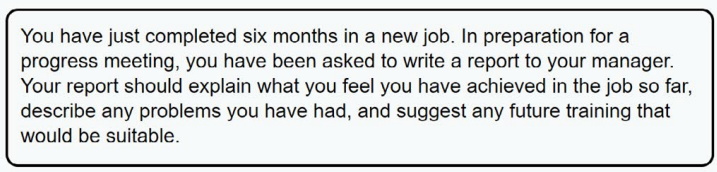
Take a look at the sample exam task shared by Cambridge on its official site.
Read the task carefully and underline the three things you should not forget to write about.
Do not forget to include:
- What I feel I have achieved in the job so far
- Describe any problems I have had
- Suggest future training that would be suitable
Now you know what you need to write about. But it’s not time to get started yet.
2. Before you start writing
Before you start writing your report, you should answer the following questions:
- Does my report need a title?
Yes, your report should have a title. You can write the title once you finish writing your report, but remember to do it.
- Do I need to divide my report into different sections?
Yes, your report should be divided into different sections. There is always an introduction and a conclusion or recommendations.
TITLE
PARAGRAPH 1: INTRODUCTION
PARAGRAPH 2: (HEADING 1)
PARAGRAPH 3: (HEADING 2)
PARAGRAPH 4: (HEADING 3) This is not always the case, sometime you need two middle sections only. It depends on the task.
PARAGRAPH 5: CONCLUSION/ SUGGESTIONS/RECOMMENDATIONS
- Who am I writing to?
It’s important to know your target reader. In the sample task above, you should write the report to your manager, which means that you should use a formal tone.
3. Tips for your Report
A report should use formal language so:
- Use polite, formal language.
How can you do that? By using passive voice.
Example:
- Trainers can provide further information prior to the start of the internship. (active)
- Further information can be provided prior to the start of the internship. (passive)
- Use varied modal verbs.
(would/ should/ might / ought to)
Providing further trainer will definitely encourage prospects candidates to take part in the internship.
These suggestions will contribute to the programme’s improvement.
These suggestions would contribute to the programme’s improvement.
- Do not use too direct, personal or general language.
I don’t believe things should change. (too direct)
I am not fully convinced the quality of the course will be affected by the aforementioned factors. (less direct)
I know (too personal)
I was told that (less personal)
People here don’t like the idea of… (too general)
Workers at the factory do not embrace the idea of… (more specific)
- Use advanced connectors.
Connectors are important for any writing and reports are not the exception.
Types of connectors:
- CONTRAST
- HoweverNeverthelessAs opposed toOn the contraryAlternatively
- Conversely
- Although/ Even though
- ADDITION
- As well asAdditionallyWhat is moreOn top of that
- Apart from this
- Furthermore
- SEQUENCE
-
- First of all / Firstly
- Second / Secondly
- EXAMPLE
- In other wordsOne instance could beLet me exemplify this by
- Such as
- For instance
4. Introduction: How to write the introduction for your Report
When you write the introduction for your report, you can start with:
‘The aim of this report is to outline…’
Make sure you do not use the exact words of the task. Paraphrasing (link to the word paraphrasing) (saying something using different words) is crucial.
While you plan your report, this is the first thing you should do:
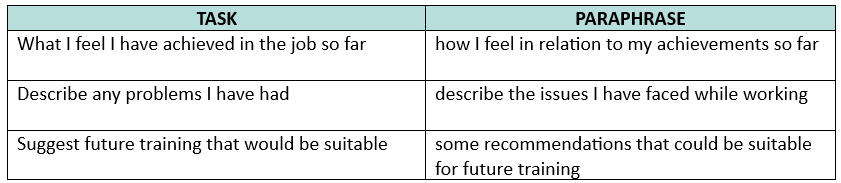
Let’s compare the wording in the task and how you can paraphrase it:
Read the following sample introduction:

5. Paragraph 1: How to write the first main paragraph of your Report
As in the introduction, rephrasing is important. First, bear in mind what the main topic of your first paragraph is.
- What I feel I have achieved in the job so far | how I feel in relation to my achievements so far
Tips
- Feel free to ‘free-style’ here. You were not told which job you were doing so you can decide the position you have in these first six months at your job.
- You will need to choose a heading for this paragraph, but you can choose it once you finish writing it.
- Make sure to use (some) of the things you should always include in your reports (connectors, passive voice, modals).
- Use an introductory main sentence and support your idea throughout the paragraph.
Read the following sample paragraph:

6. Paragraph 2: How to write the second paragraph of your report
Following the advice above, you can do the same when you write the second main paragraph.
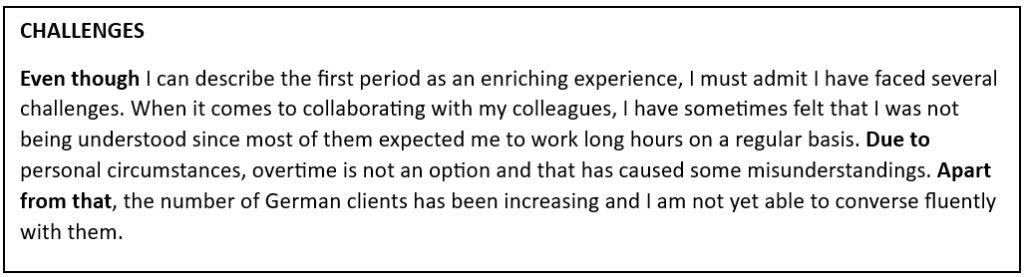
- Describe any problems I have had / describe the issues I have faced while working
Read the following second main paragraph:
7. Conclusion / Suggestions: How to write the last paragraph of your Report
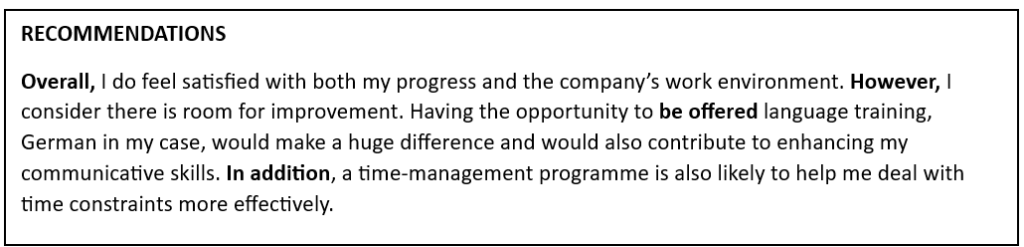
It is time to conclude, and as in the previous paragraphs, you should continue applying the same strategy.
- Suggest future training that would be suitable / some recommendations that could be suitable for future training.
8. Report Sample
Read the whole Report Sample:

9. Need any help?
I hope you find this guide useful and if you want further guidance to prepare for Cambridge C1 Advanced exam (CAE) you can book your FREE SESSION in order to know each other and to see how I can help you pass your exam with flying colours! Let’s Talk!
