



If you are planning to sit for the C1 Advanced exam and want to know how to prepare for Speaking Part 3, this blog is for you. I will help you understand what is expected and share useful phrases to help you excel in C1 Speaking Part 3.
Timing and Type of Task
- Type of Task: Collaborative Task
In Speaking Part 3, you must interact with your partner. Remember this: you need to INTERACT. There are 5 points available for interaction, so it’s essential to exchange ideas rather than focusing solely on your own responses. As Cambridge states, this part tests candidates’ ability to engage in discussion and work towards a negotiated decision. More details can be found in the Cambridge Handbook.
- Timing
Cambridge C1 Advanced Speaking Part 3 takes about 4 minutes (or 6 minutes for groups of three).
What Happens in Speaking Part 3?
The examiner will present a hypothetical situation with a question and five possible answers. You and your partner will discuss the options for 2 minutes and decide which is best and why. After 2 minutes, you will be interrupted and given an additional question to answer in 1 minute.
Useful Phrases for Speaking Part 3
Although you should not memorize phrases, practicing certain expressions can boost your confidence and help you sound more natural during the exam.
- To Get Started:
- Candidate A: Shall I start?
- Candidate B: Sure, go ahead.
- Candidate A: Well, (you can read the question in this part)
- To Interact with Your Partner:
- Wouldn’t you say that…?
- Don’t you think so?
- Do you consider… important?
- What would you say?
- Doesn’t it make sense?
- To React to Your Partner’s Questions:
- Absolutely, I couldn’t agree more.
- You’re right. I do believe the same.
- I’m sorry but I think I disagree…
- I’m not 100% sure, but I would say that…
- I’m with you. And I would like to add that…
- To Give Yourself Some Time to Think:
- As far as I know…
- Well, I would say that…
- Honestly, I do agree with you when you said that… but I’m not sure I would say that…
- I’m not familiar with… but let me say that I do believe…
- …is not my cup of tea, but in my humble opinion…
Let’s Practice!
Use the following example and analyse the candidates’ responses.
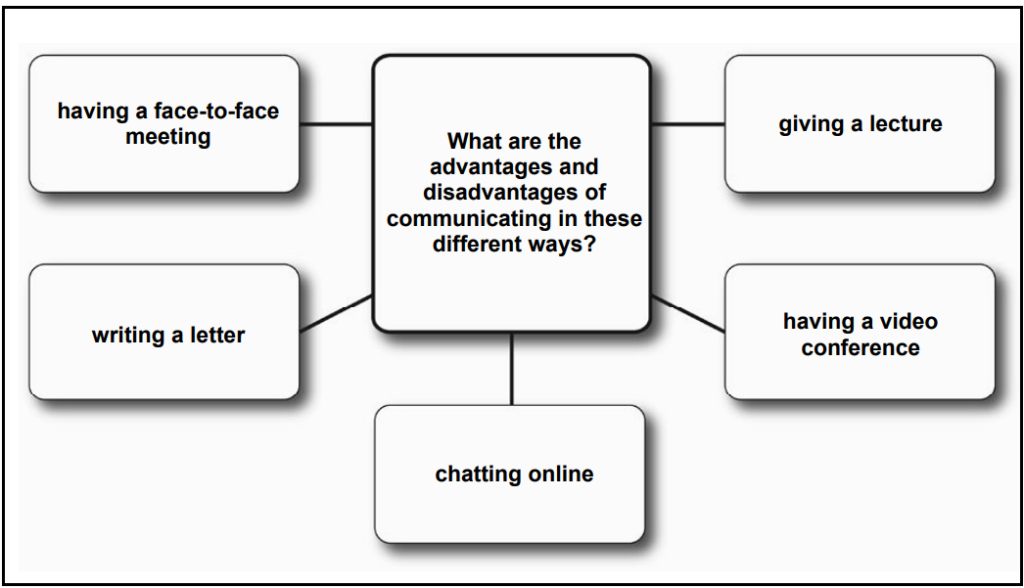
Sample Dialogue for Speaking Part 3
Candidate A: Shall I start?
Candidate B: Sure, go ahead.
Candidate A: Well, the advantages and disadvantages of these different ways of communicating are various. To start with, I would like to say that writing a letter is old-fashioned nowadays. I mean, who writes letters? However, in terms of advantages, I would say it’s something original, and if you do so, you’ll be showing that the person you write to deserves your time as hand-written letters take quite some time. Don’t you think so?
Candidate B: Definitely. And in fact, that’s an advantage and a drawback at the same time since it’s time-consuming. About having a face-to-face meeting, there’s no doubt it’s the most effective way of communicating. I mean, gestures, body language—the listener is likely to understand your message much more than if it were a written message. What would you say?
Candidate A: Sure, you’re right. On the other hand, those who are introverted will tend to avoid such a way of communicating, and they would rather go for chatting online.
Candidate B: That’s a good point. But I think that nowadays people are sick and tired of being in front of a screen the whole day, and the same goes for videoconferencing.
Candidate A: I’m sorry, but I disagree. Video conferences have opened unexplored worlds for those working remotely. They have bridged the geographical gap and enabled businesspeople to reach unimaginable places.
One-Minute Negotiation
Examiner: Thank you. Now you have about a minute to decide which two ways of communicating are the least effective.
Candidate A: Okay. I think we both agree on the fact that writing a letter is one of the least effective. Am I right?
Candidate B: Absolutely. As we said, it takes a lot of time, and I would also add that maybe the effort is not even recognised, you know.
Candidate A: You’re right. And the other one… shall we say that giving a lecture? I think that when someone gives a lecture there is no room for interaction, and, in my humble opinion, there is no communication as long as there is no interaction.
Candidate B: That’s a good point. Although I’m not familiar with that one because I haven’t been given a lecture, I think you explained it pretty well. Apart from that, all the remaining options are good ones, so I think we have reached a decision.
Check Out this Video!
Check out this video in which you can see two candidates doing the whole speaking exam. It’s an official video from Cambridge and you can get an idea of what to expect the day you sit for the exam.
So, all in all, Speaking Part 3 isn’t rocket science. Take these pieces of advice into consideration, and I’m sure you will pass this part with flying colours. If you want to read some useful tips for Speaking Parts 1 and 2 check these blogs: Speaking Part 1 and Speaking Part 2.
Would you like some professional guidance to prepare for the Cambridge C1 Advanced exam? Book a Free Let’s Talk session and find out how I can help you get your certificate!
